![L7 Labs [DEV]](https://dev.l7labs.de/l7sitedev/web/app/uploads/2020/10/L7_final_blue_short.png)
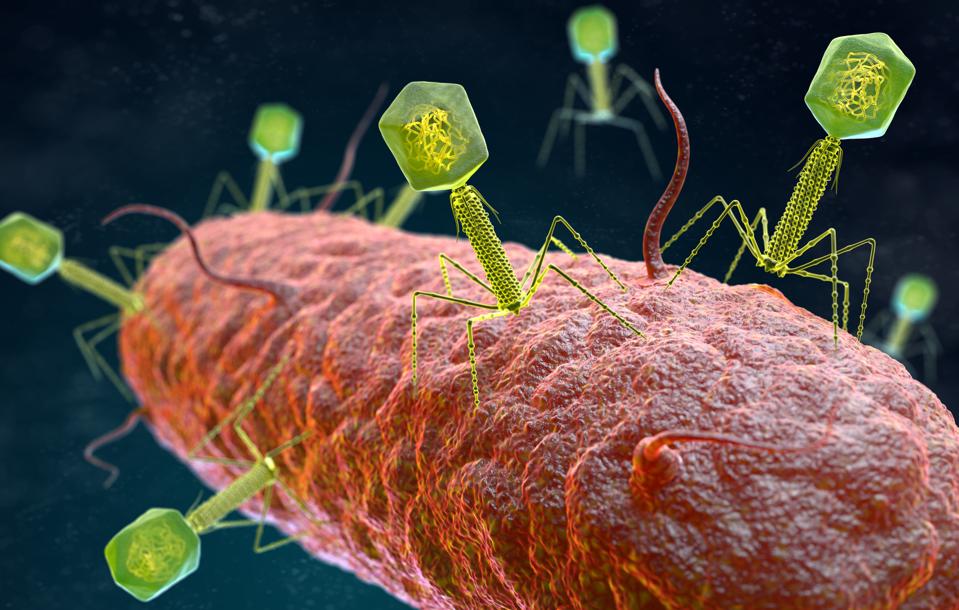
Systems biologist Marcin Wojewodzic, PhD, a researcher at the Cancer Registry of Norway, is calling for clinical trials to be carried out to test whether a bacteria eating virus could help treat patients with Covid-19.
Outlining his ideas in a scientific journal, Wojewodzic says he thinks these viruses — called bacteriophages, or ‘phages’ for short — could be used to help patients with Covid-19 in two main ways: by fighting bacterial infections and producing antibodies.

illustration of the bacteriophage virus that infects and replicates within a bacterium. 3D illustration – GETTY
An antibiotic alternative
These mini viruses, which are literally called ‘bacteria devourers’ if you know your Greek, will happily munch on bacteria as much as you will let them.
Phages have actually been used to treat people with bacterial infections in Russia and surrounding countries such as Georgia since the 1920’s, but their use was abandoned in the West largely due to the advent of antibiotic use.
But, you may ask, why is this relevant? Isn’t Covid-19 caused by a virus?
It is, but one of the leading causes of death from Covid-19 is from lung inflammation due to pneumonia. This can be caused by the virus, but various reports have suggested that secondary infections with a microbe other than the SARS-CoV-2 virus – such as bacteria or fungi – are present in up to 50% of patients admitted to hospital with Covid-19.
Indeed, Wojewodzic estimates that up to 70% of hospitalized patients with Covid-19 are given antibiotics to protect them against bacterial infection.
While we are in the middle of a viral pandemic, we are also in the midst of an antibiotic resistance crisis, which the pandemic is in danger of making much worse.
“The increased use of antibiotics due to the pandemic can have many invisible public health risks. The more they are used, the more risk some bacteria will develop resistance to them, rendering their use less and less effective,” says Wojewodzic.
Phage therapy could be an effective and specific way of killing any bacterial invaders in these patients. These viruses can be used to only knock out one strain of bacteria, something most antibiotics can’t do. This could help protect the ‘good’ microbes in a person’s gut that can actually help them to stay healthy.
It’s also possible they could be used in conjunction with antibiotics to make the drugs more effective — something that has been seen in tuberculosis patients treated with both phage and antibiotics.
An antibody production factory
There has been a lot of talk about whether the immune system of people infected with Covid-19 produces antibodies and if so whether these protect them against being re-infected. One option that is being explored by a number of researchers and companies is to produce antibody-based treatments to help patients with severe SARS-CoV-2 infection fight off the virus.
Wojewodzic believes a good method of producing these antibodies could be to use phage. By artificially modifying the phage genome, they could be used as mini production factories for making protective antibodies against the SARS-CoV-2 virus.
“If this strategy works, it will hopefully buy time to enable a patient to produce their own specific antibodies against the SARS-CoV-2 virus and thus reduce the damage caused by an excessive immunological reaction,” he explained.
This technique, known as ‘phage display’ by experts, has already been used extensively by researchers and various companies to make recombinant antibodies for use as medical treatments.
For example, a company called Cambridge Antibody Technology in the UK used this technique to develop Humira (adalimumab), a blockbuster drug (now owned by the big pharma company AbbVie) that is used to treat people with rheumatoid arthritis and other autoimmune conditions. The researchers who invented this technique won the Nobel prize for their work in 2018.